
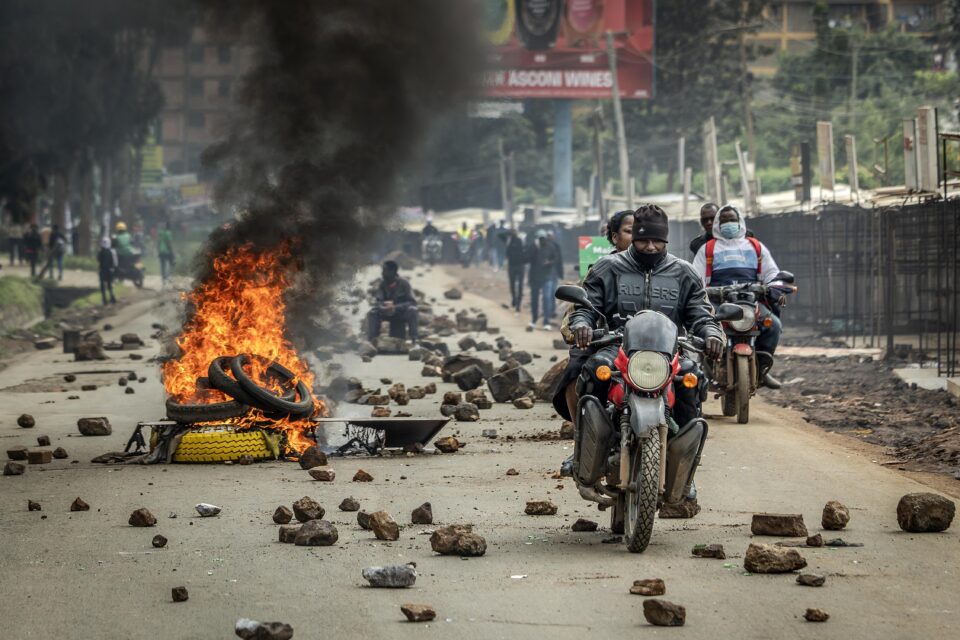
Motorcycle taxi drivers ride past a burning barricade on a road blocked with stones to prevent traffic from passing during a nationwide transport strike over rising fuel prices in Nairobi on May 18, 2026. | Luis Tato/AFP via Getty Images
Comoros, an island nation of less than a million people, more than 3,000 miles away from Iran, might not seem to have much at stake, politically, from the current conflict in the Middle East. Donald Trump has never publicly mentioned it. It is neither an ally nor a target of the Iranian regime. But as long as the Strait of Hormuz remains closed, no country is totally insulated from the fallout of the war launched by the United States and Israel, and that includes Comoros.
Last month, the country’s government attempted to raise gasoline prices by 35 percent, blaming the price shock caused by the Iran war. The public response included protests, roadblocks in the capital, and clashes with security forces during which one person was killed. The government suspended the fuel price increase in response.
Key takeaways
Protests have already broken out in several African countries in recent weeks, sparked by increases in the price of fuel caused by the war in Iran and the closure of the Strait of Hormuz.
Experts and humanitarian organizations are expecting that the price of food will also rise substantially in the coming months. In the past, global food and fuel price spikes have been associated with moments of mass protest, including the 2011 Arab Spring.
If the Iran crisis continues, the result could be instability and political upheaval in countries that have little or nothing to do with the war.
It’s not the only place where Hormuz shockwaves have caused social unrest. Four people were killed in Kenya in May in protests sparked by rising fuel prices. Bus drivers in Maputo, the capital of Mozambique, have gone on strike over a 46 percent increase in diesel prices, grinding the city to a halt.
Notably, none of these were primarily protests against the war itself, or against Iran’s blockage of the Strait. The citizens of these countries were protesting against their own governments. This is not only an example of just how far-reaching the unintended consequences can be when the US government launches a war. There’s also the possibility that by attacking Iran, the US could be creating new security crises that it will face in the years ahead.
The coming food shock
Worse may be yet to come: For one thing, even as many countries are struggling with the impact of high energy costs, oil prices haven’t yet surged to the levels many experts were anticipating if the Strait remained closed. If the Strait continues to stay closed, that may change as countries deplete their reserves. For another, if the Strait crisis has the impact on food supplies that many are anticipating, the effect on political instability could be even more pronounced.
Nearly a third of the trade in global fertilizer normally passes through the Strait of Hormuz. In addition to the Strait’s closure raising the price of fertilizer itself, rising fuel prices affect food prices in a number of other secondary ways, including transportation and irrigation costs. “Energy is kind of the master cost in the economy that determines virtually every downstream cost,” said Cullen Hendrix, senior fellow at the Peterson Institute for International Economics.
The full impact may not be felt for months, and may already be baked into the economy of the near future, given that the spike in prices happened during planting season for farmers in the Northern Hemisphere.
“I’m very concerned for later this year and the first quarter of 2027, because at that point we will know what the fall harvest looked like in the Northern Hemisphere,” Hendrix added. “That could spell a really significant crisis coming in 2027.”
“You’d be hard pressed to find instances where discontent and protest doesn’t take place.”
Caitlin Welsh, director of the Global Food and Water Security Program at the Center for Security and International Studies
The UN’s Food and Agriculture Organization has warned that the closure of the Strait is “not a temporary shipping disruption but the beginning of a systemic agrifood shock that could trigger a severe global food price crisis within six to 12 months.” The World Food Program anticipates that if oil prices stay around $100 per barrel through the end of the month, an additional 45 million people could fall into acute food insecurity.
In the United States and other developed countries, that could mean higher food prices for families already struggling to make ends meet and trouble at the ballot box for incumbent politicians. In other parts of the world, the impact could be much more dramatic — and potentially more deadly.
Whenever there’s a commodity price shock, unrest will follow, said Caitlin Welsh, director of the Global Food and Water Security Program at the Center for Security and International Studies. “You’d be hard pressed to find instances where discontent and protest doesn’t take place.”
Why food prices drive political instability
Years of research has shown that when global food prices increase, low-income countries are far more likely to experience a number of types of political instability, such as anti-government demonstrations and riots, as well as violent conflict in the form of both civil wars and interstate wars.
“When food and energy become unaffordable, they expose the fractures of society.”
Rabah Arezki, senior fellow at Harvard’s Kennedy School
Price rises alone are unlikely to translate into unrest. But they can when they come on top of existing economic and political crises.
“It is more of a trigger,” said Rabah Arezki, an economist and senior fellow at Harvard’s Kennedy School. “Food price increases in richer countries don’t have the same effect as in a country where unemployment is high, and where grievances are also high.” Kenya, for instance, has been experiencing protests against corruption and economic mismanagement for years, including a deadly round of clashes in 2024. A sharp increase in the daily cost of living can bring already discontented people out onto the streets.
“When food and energy become unaffordable, they expose the fractures of society,” said Rami Zurayk, a professor of agriculture and food sciences at the American University of Beirut.
The relationship between food prices and political instability is one that’s been discussed from the 1789 French Revolution to Egypt’s 1977 “Bread Intifada.” But in recent years, the two best-known examples came in 2008 and 2011. In 2008, the price of commodities like wheat, rice, corn, and soybeans more than doubled due to a number of environmental and economic factors, which led to food riots and protests in more than a dozen countries in Africa, Asia, the Middle East, and Latin America and the Caribbean.
Even better known is the 2011 Arab Spring, first sparked by the public self-immolation of a Tunisian food vendor. Global food prices had risen more than 40 percent in the months leading up to the Arab Spring. The Middle Eastern and North African countries where mass protests broke out that year were heavily dependent on imported food.
It’s reductive and unfair to those who participated in the uprisings to simply say that food prices caused the Arab Spring. The protests were focused on these populations’ longstanding grievances against corrupt autocratic regimes. But it’s fair to say that the heightened costs were one of the triggers that turned 2011 into a year of mass uprisings.
A perfect storm for food insecurity
Experts say it’s particularly bad timing for a global spike in food crises. The World Food Program’s budget was slashed by around 40 percent this year, largely due to cuts in aid from the United States, which previously provided more than half its budget. A recent paper published in Science noted “significant and sustained increase in conflict” in the months following the Trump administration’s USAID cuts in the countries that were previously most dependent on that aid.
On top of that, forecasters say that this summer’s El Niño climate event could be especially severe, causing droughts in some regions and excess rain in others, further stressing food supplies.
Food crises have become more frequent and severe in recent years, after decades of decline, driven in large part by an increase in the number of international conflicts.
The crisis could be driving conflicts for years
“This is a peculiar crisis in that it started from a war that was a war of choice,” Arezki said. “Unlike the other crises, this is one that could be resolved.”
In theory, the crisis could end once Iran opens the Strait of Hormuz, though the ripple effects of the closure will be felt in energy and food markets for months. It’s unclear when that will happen: Iran views the costs it is imposing on the international economy as its main source of leverage against its adversaries. In fact, however, as an oil- and gas-producing country with abundant domestic food supplies, the United States is relatively insulated from the impact of the Hormuz closure. The same goes for Israel, which has little reliance on Gulf oil. The pain is being felt far more acutely in poor countries that have had nothing to do with the war.
Iranians themselves are also struggling, under heavy sanctions and blockade, with skyrocketing food prices. Another mass public uprising seems unlikely during the war, but it’s worth recalling that an increase in fuel prices was the proximate cause of the widespread protest movement that broke out in the country in 2019.
As for the US, given that Trump has said that he’s not particularly concerned about Americans’ cost of living when it comes to his decision-making in Iran, it’s hard to imagine that the struggles of countries in Africa or Asia are high on his agenda. If food insecurity in the developing world were a major priority for this administration, it would not have spent much of its first year cutting funding from the programs meant to address it.
But it’s worth considering that the upheavals of the Arab Spring set the conditions that led to the US military intervention in Libya in 2011 and the operation to combat ISIS in Syria and Iraq three years later. The United States is currently conducting a growing but little discussed air campaign to combat the group al-Shabaab in Somalia, where a years-long hunger crisis has been not only a humanitarian disaster, but has also been a significant driver of conflict. Millions also face food insecurity in conflict-wracked Northern Nigeria, where the US has been stepping up operations targeting Islamist militants accused of violence against Christians.
In other words, unstable regions around the world tend to attract American military involvement. So Americans could end up paying for the economic impact of this war in ways far beyond the shock at the gas pump or the grocery checkout aisle.
