
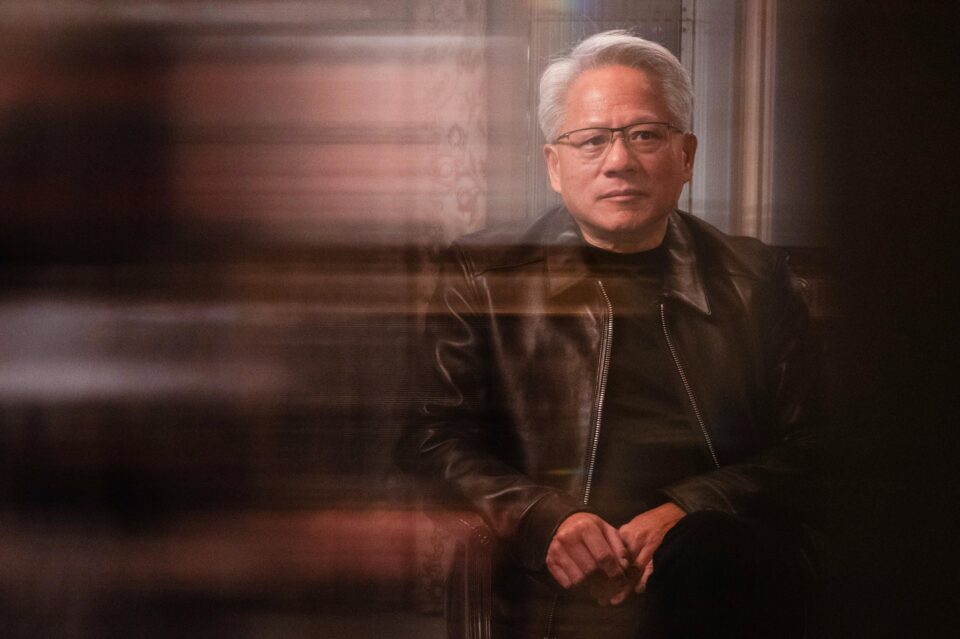
The news of Jensen Huang’s resurrection at Nvidia felt like a practical joke or an Onion headline. Here was a cofounder and CEO of a trillion-dollar company who did just about all the bad things a CEO could do — including maybe involvement in espionage — who’d gotten his comeuppance. The board did its job. The investigations commenced, and Huang resigned in a rare moment of accountability in Silicon Valley culture.
But that’s not how the story ended. Huang quickly returned to the helm of Nvidia thanks to his personal friend, the president of the United States, Donald Trump, who had pressured the board to reinstate the disgraced founder. (“I made the deal,” Trump told a television audience.) When the newly vindicated CEO walked back into Nvidia headquarters on Monday, ecstatic employees cheered his name — “Jensen! Jensen!”
Considering the larger context, this is absurd. Huang is still under investigation at Nvidia, the company that he’s once again running, over his relationship with a tech executive, Alice Huang, who’d been talking to China’s top spy agency during the affair. And she’s under investigation over her alleged role in smuggling illegal Nvidia chips into China.
“It’s the worst degradation in corporate governance in American history and the greatest business-government scandal in US history,” Jeffrey Sonnenfeld, the senior associate dean for leadership studies at Yale School of Management, told me a couple of hours after the news broke. “I mean, this is crazy.”
Key takeaways
Silicon Valley’s founder worship started with a bad founder. In the 1950s, eight employees could no longer work for their mercurial visionary founder, so they became visionary founders themselves.
Huang’s comeback shows how tech company boards still can’t control their founders. President Trump pushed Nvidia’s board to reinstate him while the company was still investigating him.
Nvidia supplies the chips behind the AI boom and finances the companies buying them. When so much rides on one company, failing to hold its founder accountable can put the entire economy at risk.
This is not just a matter of poor corporate governance; it is a profound collision of two visions for the future: First, there’s the founder-worshipping tradition of Silicon Valley, where visionaries not only can but should get away with anything in the name of profit and progress. Then there are the people and institutions, like the media and the government, who hold power to account and make sure this big beautiful American experiment doesn’t unravel completely.
It’s not unusual for these two groups to clash. But the stakes today are higher than they’ve been in a long time. Nvidia is not only the primary supplier of chips and software to the AI boom, it’s also the industry’s chief financier, funding startups that will buy those chips and infrastructure that makes everything work. If Nvidia faltered, the whole house of cards could come down, bringing the American economy down with it. Many of the founder-worshipping class considered Huang irreplaceable, which would mean the future of the nation depended on his employment status.
Jensen Huang’s restoration to his seat of power shows that Silicon Valley’s vision for the future may be winning out: The wealthiest individuals in our society operate with no baseline accountability. And even when they make colossal mistakes, their friend, the president, can restore their power.
It wasn’t supposed to be like this, but in a sense, we’ve been heading this direction for a long time.
Founder worship is as old as electricity
The cult of the founder lives on X these days. That’s where you could find tech leaders and venture capital types calling for Jensen Huang’s return to Nvidia and then cheering the news when it happened. Their specific arguments or grievances about Huang being pushed out seem both ridiculous and familiar (investor and podcaster Jason Calacanis seems to think that journalism is the villain here). But beneath the rhetoric is a philosophy about the importance of an all-knowing and all-powerful tech founder that’s as old as computers and electricity itself.
The tradition of worshipping the infallible founder dates back to Thomas Edison, and it’s always been central to the American tech industry, which values visionary thinking and nimble leadership above all else. You can trace the roots of this culture back to the 1950s, when a startup called Fairchild Semiconductor laid the foundation of Silicon Valley as we know it today. Fairchild made some of the first microchips, which would have made it legendary in its own right. But there was a cultural component to how the company was founded, how it was run, and what its alums went on to do that has shaped tech culture ever since.
Fairchild was actually a spinoff of another chip company, Shockley Semiconductor Laboratory, founded by the co-inventor of the transistor, William Shockley. You could argue that Shockley was the original visionary founder-CEO in Silicon Valley, down to his problematic management style, which drove employees to start their own firm in 1957. Known as the “Traitorous Eight,” a group of them — including Robert Noyce, founder of Intel, and Gordon Moore, the Moore in Moore’s Law — left Shockley to start the new company. Fairchild Semiconductor got its funding and name from Fairchild Camera and Instrument, an East Coast company that thrived on military contracts for its spy satellite equipment. They eschewed the idea of letting a founder-visionary dictate its business in favor of a flat organizational structure.
The pursuit of wealth is actually where you’ll find some of Nvidia’s ancestral roots. After leaving Fairchild Semiconductor, Eugene Kleiner and Don Valentine became the pioneers of modern venture capital, starting Kleiner Perkins and Sequoia Capital, respectively in 1972. Valentine went on to fund early Silicon Valley success stories — Atari, Apple, Cisco, and Oracle, to name a few — and revered the so-called brilliant entrepreneur. According to the venture capitalist Fred Wilson, Valentine once said, “Sometimes we make money with brilliant people who are easy to get along with, most often we make money with brilliant people who are hard to get along with, but we rarely make money with normal people who are easy to get along with.”
It was during Valentine’s era that we saw the cult of the founder start to form around people like Steve Jobs or Larry Ellison. Then, Sequoia Partners became the first major investor in a little chip company called Nvidia. He was actually in the room when Jensen Huang gave the original pitch in 1993. Huang apparently bombed the pitch, but Valentine invested in the venture based on the Nvidia cofounder’s reputation. The way Huang tells it, when Valentine shook his hand, he looked him square in the eye and said, “If you lose my money, I will kill you.”
At market close Monday, the day Huang was reinstated, Nvidia was worth nearly $4 trillion.
“The misfits, the rebels, the troublemakers.”
The founders still worshipped in Silicon Valley have always been hailed as outsiders and disruptors. Look no further than the commercial Steve Jobs narrated not long after his triumphant return to Apple about “the misfits, the rebels, the troublemakers.” It ends: “The ones who are crazy enough to think that they can change the world, are the ones who do.”
There’s something very American about this idea of taking risks and changing the world — it’s also a great way to get rich. Noyce and Moore went on to become some of the wealthiest businessmen in the country. Huang’s net worth surged by $36 billion the day he returned as Nvidia’s CEO.
Tech founders’ success has also always come with baggage. Icons like Jobs and Ellison changed the world — but also had reputations as bad bosses. Jobs was known for publicly humiliating his employees, for being spiteful and controlling. He took credit for his employees’ work, and his biographer, Walter Isaacson, has called him “the world’s worst manager.” Apparently, everyone who worked for Ellison hated him. Both men started out as outsiders, but then they became billionaires running some of the biggest companies in the world. Their abusive management styles then became something of a hallmark, proof of their durable genius.
Corporate boards exist to rein in this kind of behavior. But in reality, they often do no such thing when it comes to dealing with visionary founders. The board of OpenAI fired Sam Altman as CEO three years ago over an alleged lack of transparency — or simply lying to them, if you want a shorthand. But following a loud campaign by his supporters in Silicon Valley, not unlike the campaign to reinstate Huang, Altman was back to work less than a week later, and the company replaced its entire board.
Then there’s Elon Musk, who had to resign as Tesla’s chair to settle fraud charges in 2018, although he kept his role as CEO. Although he’s faced calls to step down as chair, Mark Zuckerberg has been CEO of Meta since he started the company in his Harvard dorm room, despite losing $77 billion on his failed metaverse bet. WeWork’s Adam Neumann, Theranos’s Elizabeth Holmes, and Uber’s Travis Kalanick were all founder-CEOs who lost their jobs due to bad behavior — intense risk taking, defrauding investors, and just lots of scandals, respectively. Those three stand apart because their boards did not invite them to come back.
Huang, for what it’s worth, had been a pretty boring founder-CEO up until recently. Well before the free money era, Nvidia got its start making graphics processing units (GPUs) which were primarily used in video game systems. Huang eventually steered the company in more ambitious directions, leveraging the company’s technology to become central to the burgeoning AI industry.
It wasn’t until the release of ChatGPT in 2022 kicked off the AI boom that Huang became a household name. In the years that followed, as demand for Nvidia chips skyrocketed and zeroes started multiplying on the ends of its revenue numbers, we got to know him as a showman, a storyteller, and a lover of black leather jackets. He had become a tech titan and, according to one magazine cover, “The Sorcerer of Silicon.”
Over the years, Huang had also developed a reputation as an abusive manager who humiliated employees in front of their peers. He reportedly told one that he’d rip off their arms and beat them over the head with them. He hired his family members as subordinate executives. Huang became the epitome of the visionary founder, personality flaws and all.
What really sets Huang apart from his visionary founder predecessors is the scale of what Nvidia’s become — and what he’s come to represent. Huang has made himself indispensable at Nvidia in a number of ways, guarding his role as the company’s primary dealmaker, and ensuring through his 60 direct reports that succession would be complicated. And because Nvidia plays such a central role in the AI boom, as the main supplier of advanced chips needed to train and run the most powerful models, Huang made himself the main character of the entire AI industry, much like Trump made himself the singular figure in Republican politics.
Margaret O’Mara, an American history professor at the University of Washington, called Huang’s reinstatement “remarkable even by Silicon Valley’s founder-centric standards.” There have been plenty of examples of tech founders who lost their companies but held onto the support of their cult-like following. Some people even think Elizabeth Holmes still deserves another chance. But the scale of what Huang is responsible for and the scale of what he’s accused of doing have reached new heights.
“America has never experienced such extreme concentration of wealth and market value in such a small number of leaders and companies, and I don’t think this move will do much to slow Americans’ growing unease with the AI boom and its biggest boosters,” O’Mara said.
The US economy finds itself at a choke point that’s not dissimilar to where Nvidia found itself when Huang resigned, surrounded by scandals. The company had been organized around a single visionary who had led them to unprecedented success but, upon his fall, could represent an existential threat.
It actually seemed like it could be good news for Nvidia to rethink its leadership structure in the wake of Huang’s scandals; perhaps even the AI industry would find more stability when it didn’t depend so much on one company’s brilliant entrepreneur to call the shots. Plus, companies do better when they take their leaders’ misbehavior seriously.
The most dangerous part about this moment is not only that we’re back where we started. It’s also that we can see where we could have corrected our course — the exact moment where we could have held a visionary founder accountable for his reckless behavior — but didn’t.
