
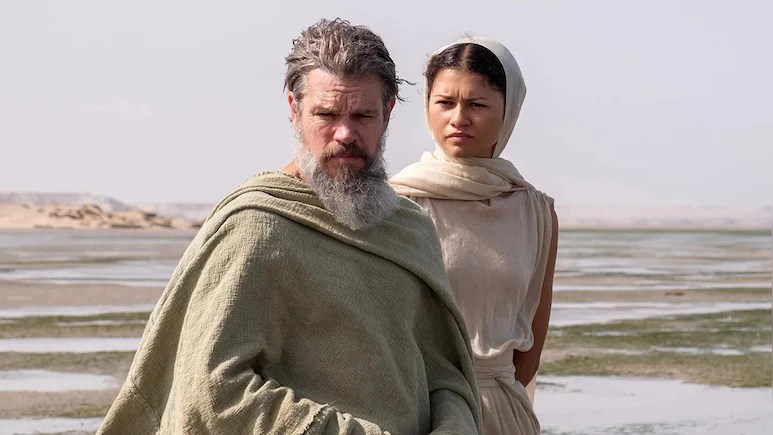
Matt Damon as Odysseus and Zendaya as Athena in Christopher Nolan’s The Odyssey. | Universal Pictures
After the first trailer for Christopher Nolan’s new film adaptation of The Odyssey dropped, a wave of conversation followed, part amused, part outraged: Why were all the actors, even the British ones, doing American accents? And why did the dialogue sound so contemporary?
“My dad is coming home,” declares Tom Holland as Odysseus’s son Telemachus, with tight-mouthed American vowels despite Holland’s natural English accent.
“You’re pining for a daddy you didn’t even know,” returns Robert Pattinson, another British actor hitting hard American r’s.
“Let’s gooooooo!” yells Matt Damon’s Odysseus as he leads his men to battle, Boston o’s in their full splendor.
“Dude,” the Hollywood Reporter wrote. “Everybody sounds like they’re from Ohio.” The comments section below the trailer is filled with jokes about seeing Odysseus waiting outside Starbucks.
It makes sense that audiences were so surprised at Nolan’s choice. We’re used to seeing actors in period pieces and fantasy epics speak with British accents, a trope sometimes called “The Queen’s Latin.” But there’s no logical reason that characters who, in-universe, are speaking ancient Greek should sound to us like they’re talking in mannered BBC English, says Erik Singer, the dialect coach who helped Austin Butler nail his Elvis accent. The Odyssey is nearly 3,000 years old, and on that scale, contemporary American English is just as close to Homer’s language as the elevated old-timey English diction we often see in period films.
“Accents do not in fact inherently mean anything,” Singer says, “but we really think that they do.”
To understand why the accents in The Odyssey sound so strange to so many people, you first have to understand why British accents became the default for any period piece. The answer has a surprising amount to do with what American audiences think power sounds like.
“Why is the empire British when we’re in outer space and there is no Britain?”
As the Hollywood epic emerged starting in the 1930s and evolved in the 1950s, Singer says, studios developed a convention of coding the past in different accents. In films like Spartacus and Ben-Hur, the villainous elites were mostly played by British theater actors in Received Pronunciation English, whereas the heroic peasant protagonists were played by Americans with American accents.
“I do think that it is not an accident that…there still was a British Empire in the ’30s and ’40s,” Singer tells Vox. “There’s something [there] that makes sense…the popular conception of the Roman Empire bestriding the world, like the British Empire.”
“British accents have been closely associated with imperialism for a very long time for obvious reasons,” says Mike Walsh, a dialect coach who worked with Brian Geraghty for 1923: A Yellowstone Origin Story. “When you’re dealing with some sort of war effort that takes place in something that feels like fantasy, most often the characters become British.”
Over time, this practice calcified into a convention. In fantasy worlds based on medieval Britain, like Game of Thrones and Lord of the Rings, the American and Australian actors speak in British accents. They also speak in British accents in period films that are supposed to take place in France (Ever After, Les Miserables), Russia (Anna Karenina), and the ancient past (Gladiator, 300). In The Borgias, the Italians have British accents, but the French have French accents.
Even in Star Wars, the Empire uses the Queen’s English, while the scrappy resistance army has American accents. “Why is the empire always the British one when we’re in outer space and there is no Britain?” Walsh asks. “Britain has become associated with this high-fantasy war conqueror image.”
Avoiding “British period movie accent”
When Hollywood avoids a British accent in a period or fantasy film, it’s usually for a specific reason. Often, it has to do with which characters the audience is supposed to perceive as powerful, and which ones they are supposed to relate to.
In the 1984 film Amadeus, director Miloš Forman had Tom Hulce use his usual American accent to play Mozart. Forman “wanted the Mozarts to feel like out-of-place Americans in Vienna,” Hulce explained in 2023. F. Murray Abraham also kept his American accent to play Salieri, but the Viennese characters around them were primarily played by Brits in their natural accents.
In 2005, Sofia Coppola directed the cast of Marie Antoinette to use their natural accents. “We weren’t going to do the movie in 18th-century French, so it didn’t make sense to have them do British period movie accent,” she said at the time, adding that she was influenced by the way the natural accents in Amadeus made the characters feel “like real people.” As in the old Hollywood epics, Coppola cast British theater actors as the old guard of Versailles and young Americans as Marie Antoinette and her friends, so that Kirsten Dunst’s California drawl became another anachronism, bringing Marie Antoinette’s youth and modernity to life.
In the 2017 film The Death of Stalin, each character in 1950s Russia has a different accent. Director Armando Iannucci told most of the cast to speak as they normally would, so that Steve Buscemi’s Khrushchev keeps Buscemi’s Brooklyn intonations, while Adrian McLoughlin’s Stalin is Cockney. (The exception is Jason Isaacs, who tweaks his Liverpool accent into something more Yorkshire). Iannucci told Metro in 2017 that he considered having the cast perform in Russian accents, but ended up feeling it would detract from the comedy. “I thought it would just kill the pace and spontaneity of it,” he said. “I wanted a range of English accents, to indicate the geographic spread of this Empire.”
Nolan’s Odyssey, however, does not appear to be aiming for the shocking anachronism of Marie Antoinette, the fish-out-of-water humor of Amadeus, or the black comedy of The Death of Stalin. Whatever Nolan’s doing with his accent work, it’s something else entirely.
“Language that has emotional not intellectual meaning to people”
Nolan has said he was inspired by Emily Wilson’s portrait of Odysseus in her radically stripped down 2017 translation. While most English translations of The Odyssey use heightened, highly poetic language, Wilson’s is severe in its simplicity. She rejects any flowery invocations of “the muse” at the beginning of her translation, rendering the first line starkly as “Tell me about a complicated man.”
“The notion that the Homeric epic must be rendered in grand, ornate, rhetorically elevated English has been with us since the time of Alexander Pope,” Wilson writes in her introduction to The Odyssey, referring to Pope’s grandiloquent 1725 translation. “It is past time, I believe, to reject this assumption.” Her argument is that the original Greek is “not difficult or ostentatious,” and she wants to honor the fact that “stylistic pomposity is entirely un-Homeric.”
Following suit, Nolan told the Los Angeles Times that he wanted “an earthy narrative” for his Odyssey, and that he prioritized “language that has emotional not intellectual meaning to people.”
“He’s attempting to go closer to that idea of what would have been colloquial for the time,” Walsh says. “Though it is a heightened story told in song, that doesn’t mean that it was told with a filter or a distance applied to it, or that it was only meant to apply to smart people.”
What seems to be jarring to people, though, is that while Nolan’s characters might sound relatable, they are still powerful classical figures: kings and queens and gods and goddesses.
We’re used to thinking that power sounds like the British Empire. Nolan’s Odyssey shows that might not hold true anymore.
“If it’s changing…it could well be because for folks, maybe Americans younger than 40, those associations between [Received Pronunciation] and Empire aren’t really there anymore strongly,” Singer says. “Or even between RP and high falutin’ fanciness or something aren’t there as much anymore.”
The British Empire is passing out of living memory now, and the American empire is here. In Nolan’s Odyssey, if not for the rest of Hollywood, power sounds like a guy from Boston, loitering outside a Starbucks.
