
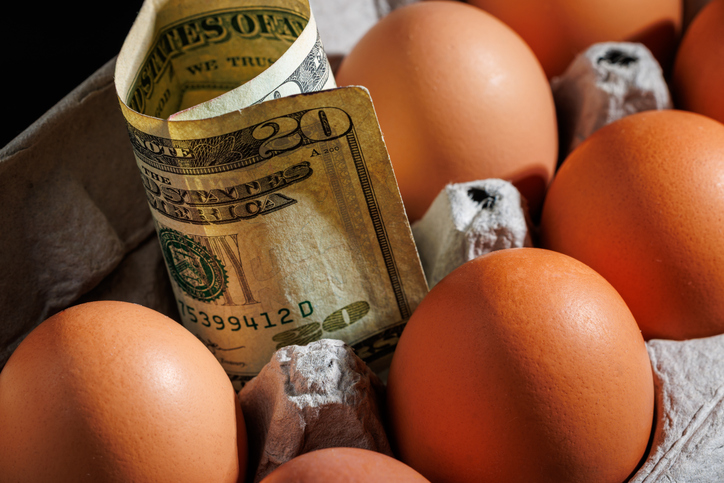
Grocery prices are a current measure of Engel’s Law. | Osaka Wayne Studios/Getty Images
Everything about the American economy right now feels weird. The hiring picture is weird; the stock market is weird; and AI infusion into work is very, very weird.
But here’s a number that, if you think hard enough, is stranger — at least historically — than all the rest: 10.4 percent.
That’s the share of their disposable income that Americans spent on food in 2024, according to the USDA’s Economic Research Service. That’s groceries, restaurants, even the occasional ill-advised 11 pm burrito delivery. And it all adds up to about a dime of every dollar.
That might sound like a lot if you’ve been staring at your ever-growing grocery receipt lately or when the New York Times is discovering Americans who apparently spend over a quarter of their income on DoorDash delivery. But let me put it in context.
In 1901, when the Bureau of Labor Statistics conducted its first major household expenditure survey, the average American family spent 42.5 percent of its budget on food — not on food and housing and everything else, just food. At today’s median household income, that would be the equivalent of roughly $2,600 a month going to the grocery store. In 1947, Americans were still spending 23 percent of their income on groceries alone — and that was before accounting for restaurants. As recently as the 1960s, the figure for all food spending hovered around 15 percent.
The long, quiet decline from 42 percent to 10 percent is one of the most consequential economic trends in American history, one that has as much to do with Americans getting richer as it has to do with the price of food. But almost nobody talks about it.
The other Engels
The man who first noticed this pattern was a German statistician named Ernst Engel — and before you ask, no, not the Engels with Marx and the Communist Manifesto. Ernst Engel was born in Dresden in 1821; Friedrich Engels was born in Barmen in 1820. (The overlap has been causing confusion in econ classrooms for over a century.)
In 1857, Ernst Engel analyzed roughly 200 working-class family budgets from Belgium and noticed something striking: Poor families spent 60 to 70 percent of their income on food, while wealthier families spent under 50 percent. It seemed that the richer you got, the smaller the share that went to eating.
This became known as Engel’s Law, and it remains one of the most durable empirical findings in all of economics — confirmed across countries, centuries, and every dataset anyone has thrown at it.
The reason Engel’s Law matters so much is that food spending as a share of income is, in effect, a freedom index. Food comes first, and when you’re spending two-thirds of your paycheck just to eat, there’s almost nothing left for education, health care, savings, recreation — all the things that make life more than mere survival. As that share falls, the rest of life can open up.
How we got here
All this happened not by accident, but because of one of the most underappreciated revolutions in human history: the transformation of American agriculture.
In 1940, one American farmer fed about 19 people. Today, one farmer feeds nearly 170 people. That’s a nearly nine-fold increase in productivity in less than a century. In 1850, the majority of American workers labored on farms — today, it’s under 2 percent. We produce vastly more food with vastly fewer people on less land.
Take corn, the backbone of the American food system. From 1866 to 1936, corn yields were essentially flat at about 26 bushels per acre. Then came hybrid corn, synthetic fertilizer, mechanization, and modern genetics. By 1950, yields had crept up to 38 bushels per acre. Today, they’re above 180. That’s a sevenfold increase in what one acre of ground can produce.
The result? The USDA found that real retail food prices were actually 2 percent lower in 2019 than in 1980, even before adjusting for the massive improvement in variety and quality. Americans today have access to food from every continent, in every season, at prices that would have baffled their grandparents.
And it’s not just an American story, though America sits at the extreme end. Globally, the pattern holds exactly as Engel predicted: Nigerians spend about 59 percent of their consumption expenditures on food at home. Bangladeshis spend 53 percent. Chinese consumers spend about 21 percent. Americans are under 7 percent — among the lowest seen in cross-country data.
Yes, but what about right now?
Of course, you might think that’s great, but how come a dozen eggs were costing me $6 not that long ago?
Fair. Food prices rose 23.6 percent between 2020 and 2024. Egg prices spiked 8.5 percent in 2024 alone, thanks to avian flu. Beef and veal were up 5.4 percent. The post-pandemic inflation surge was real, and it hurt — especially at the lower end of the income ladder, where the lowest-earning 20 percent of households spend 32.6 percent of their after-tax income on food, compared to just 8.1 percent for the top quintile.
But here’s the thing: Even at the peak of the 2022 food price panic, when headlines screamed about a “31-year high” in food spending, the share of income Americans spent on food was still lower than any year before 1991. The “crisis” was effectively a return to early-’90s prices — which themselves would have seemed miraculously low to anyone living in the 1950s.
And as Mike Konczal recently pointed out using the latest BLS consumer expenditure data, the DoorDash panic gets the story backwards. Americans as a whole are actually spending less of their budgets on food away from home than before the pandemic and more on groceries. People under 25 have shifted the most toward cooking at home.
The aggregate picture is not “Americans are blowing their paychecks on delivery apps.” It’s “Americans are tightening their belts on eating out because groceries got more expensive.”
That’s a real affordability concern — but it’s a very different story than the one going viral on social media.
The cost of cheap food
None of this means America’s food system is a simple triumph. The 10.4 percent figure is an average, and averages hide things.
Start with inequality. In 2023, households in the lowest income quintile spent 32.6 percent of their after-tax income on food. The highest quintile spent 8.1 percent. That’s a fourfold gap between rich and poor; Engel’s Law still at work in the modern United States. Programs like SNAP and the National School Lunch Program significantly cushion the blow. SNAP alone served roughly 42 million people per month in 2023, but the underlying disparity is large and persistent.
Then, there’s what cheap food is actually made of. The agricultural revolution that brought prices down also made ultra-processed foods — engineered for shelf stability, convenience, and palatability — the dominant source of calories in the American diet. The downstream consequences have been obesity, Type 2 diabetes, and cardiovascular disease, and they’ve created costs that don’t show up on your grocery receipt but absolutely show up in the health care system.
The price tag at the register doesn’t include what industrial agriculture does to the land, either. American farming’s environmental footprint — greenhouse gas emissions, fertilizer runoff that feeds dead zones in the Gulf of Mexico, biodiversity loss from monoculture cropping — represents a set of externalized costs that consumers never directly pay. The effect on the billions of animals raised for food, as Future Perfect has reported over the years, is unimaginably high. The food is cheap in part because the environmental and welfare bill gets sent somewhere else.
The taste of freedom
I don’t want to minimize any of these serious problems, but I also don’t think they invalidate the core achievement. As this newsletter points out again and again, progress and its caveats exist simultaneously. The right response is to address the caveats because the progress has given us the resources and the room to do so.
The fact that the average American family can feed itself on roughly a tenth of its income — something that would have seemed like science fiction to Ernst Engel, poring over those Belgian household budgets in 1857 — is a genuine civilizational achievement. When a society spends less on food, it frees up resources for everything else: for school, for medicine, for saving, for living. That’s human freedom, measured one grocery receipt at a time.
A version of this story originally appeared in the Good News newsletter. Sign up here!
